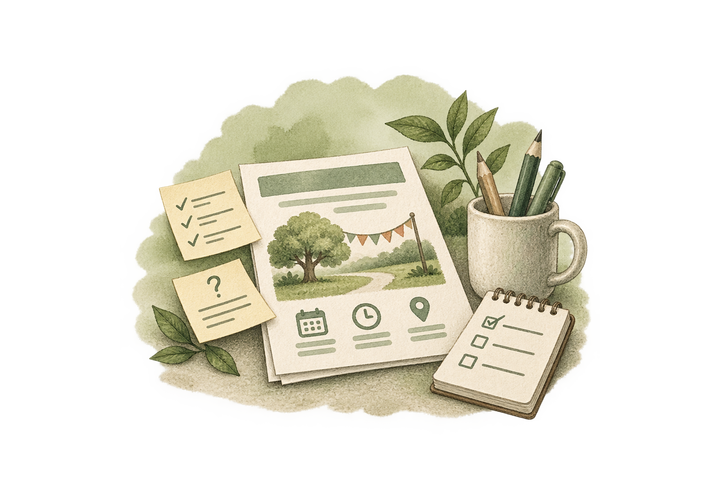
Imagine you are finishing a poster for a community event. You have spent the evening choosing the photo, arranging the words, and trying to make it look clear. A colleague studies it and says, “This is confusing.”
Your face grows warm. You want to say, “So you think I am bad at this?” But the poster has a simpler problem than that. People need to find the starting time quickly.
You look again. The time is there, in small letters beneath a large photograph. You can find it because you put it there. A person seeing the poster for the first time may not.
Turn a reaction into a useful question
Instead of explaining how long the design took, you ask, “What did you look for first?”
Your colleague says, “The date, the time, and where to go. The picture caught my eye, but then I had to search.”
That gives you something useful. You make those details larger and show the poster to another volunteer who has not seen it before.
You ask, “Can you tell me when and where this happens?”
She answers straight away, then says, “I still do not see the street name.” She is right. You add it before printing.
The changes take twenty minutes. Printing the first version would have cost more time and money to correct later.
Later, another person says, “You are just not a creative person.”
That hurts more, but tells you less. You ask, “Is there something specific that makes the poster difficult to use?”
The person shrugs. There is nothing clear to test or fix in that remark. You do not need to turn it into a verdict on your future or your worth. You keep the practical changes that helped the poster and leave the broad judgment alone.
What we can learn
Feedback is information to examine. It does not become true just because someone sounds certain. It does not become useless just because it feels uncomfortable.
Ask for the part you can see or test. “You communicate badly” is hard to use. “The customer could not find the delivery date” gives you something to check. You might ask, “Can you show me where you became unsure?”
It also helps to remember the purpose of the work. A poster needs to help readers find an event. A class assignment may need to match a marking guide. A household arrangement needs to work for the people sharing it. When the purpose is clear, opinions are easier to weigh.
You do not need to answer immediately. “I will look at that and come back to you” gives you room to think. Then you can choose one change and see whether it helps.
You can also protect your self-respect. “I can discuss the work, but please do not insult me” keeps the focus where it belongs. If saying that feels unsafe, seek support from someone appropriate. Learning does not require accepting humiliation.
Try this today
Think of one comment you have received before, or use a low-risk practice example like a message, school task, or social post. Write two lines: first, turn the comment into a checkable question such as "What exactly was hard to find or understand?" Then write one small change you would test.