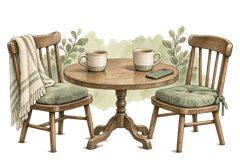
Imagine you are at home with your phone in one hand and your headphones on the table. A song you love is already queued. Your sketchbook is open beside a pile of laundry. Then someone in the kitchen calls, “Dinner in twenty. Can you set the plates?”
There is often one more useful thing to do: another message, another chore, another task at home. Some responsibilities really cannot wait. But if every pleasant moment must come only after everything is fully finished, enjoyment can keep moving further away.
Ten minutes before dinner
Suppose you look at the table, then at the clock, and say, “I can help. I’m taking ten minutes first, then I’ll set the plates.”
You put on one song and begin to draw the mug in front of you. The first lines look awkward, and you almost tear out the page.
The other person steps in and smiles. “Bad sketch?”
“Maybe. I’m trying not to make it into homework,” you say.
When the song ends, you want to keep going until the drawing looks better. That is the familiar trap: a small break becoming something to improve, then something to prove. Instead, you close the sketchbook, carry the plates to the table, and join the kitchen work.
The page is unfinished. Dinner still happens. Later that night, you look at the drawing again and realise the useful part was not the result. It was those ten minutes when you did something you liked without waiting to deserve it.
On other days, you may not feel like drawing at all, and there is no need to force it. This is not a rule that you must feel cheerful. It is simply permission to make room for a pleasant moment when one is available, while urgent needs stay covered and shared work stays fair.
What we can learn
A short enjoyable activity can matter even if it produces nothing finished, useful, or impressive. Its value can be in the experience itself.
Keep the moment small enough to fit real life. One song, a few lines in a sketchbook, or a quiet conversation can be enough.
Watch for the point where enjoyment turns into performance. Asking whether it is good enough or productive enough can steal the break you meant to take.
Make room for pleasure without neglecting urgent responsibilities or quietly handing your essential work to someone else. If other people depend on you, a clear and fair arrangement helps everyone know what to expect.
Try this today
Choose one small pleasure that fits into ten minutes today, let it stay small, and then return to what still needs your attention.